Article summary: Modernizing legacy applications without disrupting business operations is one of the most pressing challenges organizations face today. Successful modernization starts with thorough planning and stakeholder alignment — understanding system dependencies, documenting existing processes, and ensuring all parties agree on what to preserve, update, or remove. Rather than a risky “big-bang” approach, a phased, incremental strategy with pilot projects and intermediate checkpoints significantly reduces the chance of failure. It’s also critical to keep legacy systems synchronized with modernization work throughout the process, since codebases continue to evolve and any missed updates can result in outdated functionality or compliance violations. Ultimately, modernization should be viewed as a continuous journey rather than a one-time project, requiring ongoing attention, automation, and a commitment to business continuity at every stage.
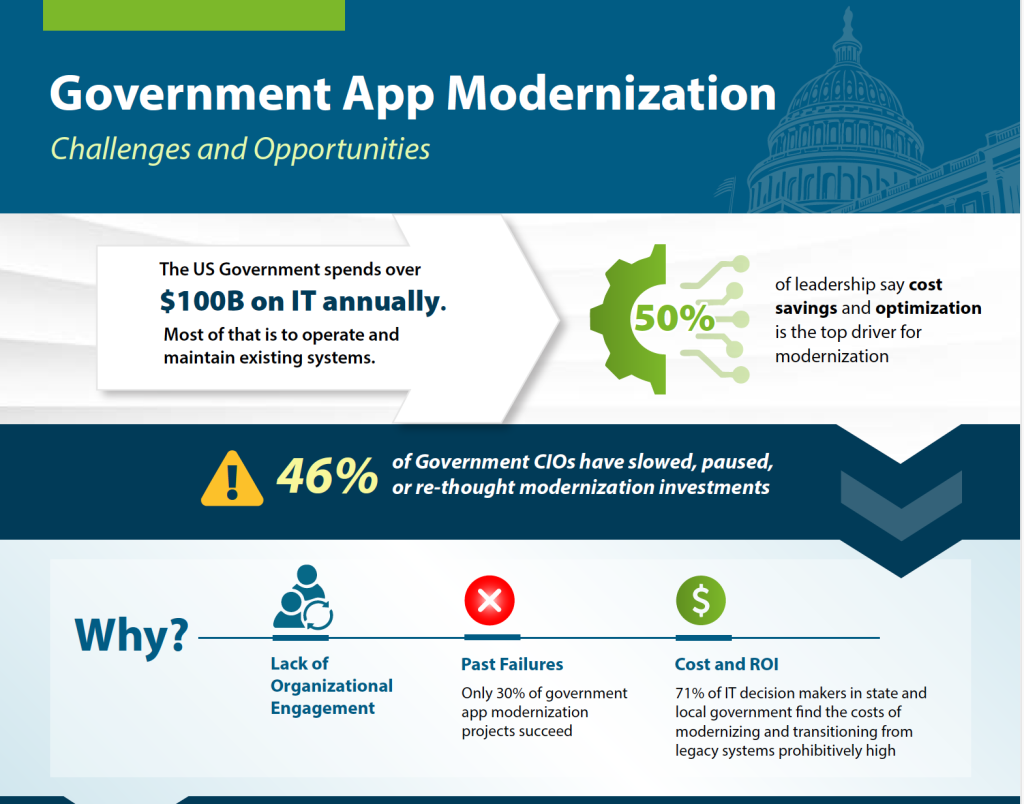
A recent industry report revealed that 92% of businesses surveyed are still relying on outdated technologies. While 41% of these organizations plan to modernize their applications in the next 12 months, there are still quite a few challenges and questions that come up along the way. As your go-to partner for application transformation, we are here to help with our latest blog series – “The Modernization Playbook”, which will be a series of posts addressing some of the top modernization implementation challenges we’re hearing and practical tips for how to overcome them. For this inaugural post, we’ll start with one of the most frequently asked questions:
How can we modernize legacy applications without disrupting business operations?
Almost every core aspect of running an organization today depends on sophisticated software systems. From financial operations and resource planning to talent management and communication, organizational tech stacks continue to expand—enterprises with at least 5,000 employees now manage nearly 400 applications on average, with this number increasing proportionally to organization size. If these mission-critical systems succumb to legacy risks or failures, business operations can grind to a halt.
However, modernizing legacy applications remains challenging, and even with cutting-edge automation tools, these projects often span months or years depending on system complexity and scope. Adding evolving regulations and compliance requirements to the mix, organizations must consider how to keep modernization efforts aligned with rapidly changing production environments. As IT teams deploy updated systems, they may encounter resistance from team members who have optimized their workflows around existing environments. How, then, can IT departments create a successful modernization strategy and achieve their objectives while minimizing disruption to business stakeholders and end clients?
Communicate, Collaborate and Double Down on the Details
Taking the time to properly plan a transformation initiative and devise a robust modernization strategy is imperative. This begins with aligning with your business and technical stakeholders to determine the goals of the overall transformation effort, required deadlines, available resources, and other critical factors. The more comprehensive your understanding of business needs, the better equipped you’ll be to create a plan that meets those requirements both during the modernization process and after completion.
Equally vital is conducting a thorough assessment of the application(s) in question. Understanding system dependencies will help identify which other applications will be affected by the modernization initiative and which must integrate with the modernized solution. Additionally, comprehensively documenting the policies and processes implemented in the current system and communicating these to business stakeholders enables clear decisions about what functionality to preserve, update, or remove. This ensures that when new applications are deployed, they execute the policies that align with business requirements rather than causing disruptions through incorrect or outdated processes.
Master the Blueprint Before Building the Future
The failures associated with a “big-bang” approach to application modernization are well-documented. The risks of an “all or nothing” strategy—with no intermediate checkpoints or validation mechanisms—are substantial, particularly when it comes to system failures or disruptions. Despite the urgency around modernizing legacy applications, taking time to establish a foundation for success yields better outcomes. This is where a phased approach or incremental modernization strategy proves invaluable.
Using our proven 5-step methodology, organizations have successfully leveraged comprehensive assessments to divide large modernization initiatives into manageable segments that align with business requirements. Specific modernization paths can be selected for each component, with processes validated through pilot projects featuring intermediate deliverables. Business stakeholders should be kept in the loop during these pilot projects to ensure continued alignment. Once a successful modernization strategy emerges, incorporating lessons from these pilot implementations, organizations can confidently scale their modernization efforts with significantly reduced risk. Take for example a leading healthcare insurer that used the Intellisys platform to split their move from aging systems to modern platforms into multiple phases using the platform’s business rules extraction capabilities. They successfully extracted rules from over 1.5 million lines of COBOL code and exported the relevant rules into the Drools rule engine in 8 months.
Maintain Synchronization between Legacy Systems and Modernization Work
Legacy systems must remain operational while their modern counterparts are being developed and tested. These systems require ongoing maintenance and updates to address policy changes, security requirements, compliance mandates, and other essential modifications. Most organizations cannot simply freeze their codebase, especially during extensive modernization initiatives that may span months or years. However, without properly capturing, documenting, and sharing changes made to legacy code with the modernization team, organizations risk developing a technically modern but functionally outdated application that fails to incorporate critical updates. This oversight could lead to businesses executing obsolete processes or facing compliance violations.
The Intellisys platform stands alone in addressing this challenge through its agile documentation and business rules extraction capabilities for modernizing legacy applications. Using fully automated processes, the platform analyzes newer versions of application source code and identifies changes compared to previous iterations. It goes further by generating comprehensive reports highlighting where these modifications may impact existing modernization work. This functionality enables modernization teams to remain synchronized with changes made to production systems and incorporate these updates into modernized versions. The State of New York successfully leveraged these features during their initiative to extract rules from their legacy Integrated Eligibility System (IES) as part of a transformation effort. This project, spanning three years and encompassing 31 million lines of code across three programming languages, successfully incorporated all critical updates made during the modernization timeframe.
Embrace Continuous Modernization for Long-Term Success
Modernizing legacy applications without disrupting business operations requires thorough planning, incremental implementation, and synchronization between legacy system updates and modernization work being performed. By communicating effectively with stakeholders, thoroughly assessing the systems in question, breaking down large initiatives into manageable segments, and leveraging automation tools like the Intellisys platform, organizations can successfully navigate the complexities of these initiatives. Remember that modernization should not be looked at as a one-time event but rather an ongoing journey—one that requires attention to detail, strategic foresight, and a commitment to maintaining business continuity throughout the process. As you embark on your own modernization journey, focus on creating a sustainable approach that evolves alongside your business needs, ensuring that your technology stack remains a competitive advantage rather than a liability.