EvolveWare Named in the Inaugural Gartner® Magic Quadrant™ for AI-Augmented Code Modernization Tools. Learn More

Home » Blog

EvolveWare Blog

Learn about the latest application modernization trends and practical advice for achieving success with legacy optimization & transformation initiatives.

Creating documentation has always been seen as a chore for developers. The traditionally manual aspect of it has generally been seen as boring and tedious, and it tends to get overlooked when weighed against other more immediate priorities. Because of this, it is estimated that 70% of organizations do not have referenceable documentation of their portfolio.

However, not having this documentation can result in major company crises as personnel retire and organizations attempt to update their applications in various ways. For example, the TSB failure in the UK where 2 million customers were locked out of their accounts after banking technology was moved to a new platform was partially attributed to not fully understanding the scope and complexity of how the new system should work. To understand this requires you to understand the source system at a granular level, and from experience, carrying out legacy modernization projects with poor documentation increases the chance of failure by 70%.

Poor documentation reduces process efficiency as well as slows down the adoption of new methodologies and technologies, ultimately leading to increased costs and missed business opportunities. But legacy application life-cycles can be 20 to 30 years or longer, and during this time, too many changes and fixes occur to keep the original documentation updated accurately in a manual way. The unfortunate reality is the longer an application has been in existence, the further from the truth the documentation really is – if it even exists. Therefore, when an organization tries to do a legacy modernization project, they are unfortunately starting from a position of weakness and failure is the most likely outcome.

How can you prioritize creating and updating documentation while minimizing time sinks on their development team?

The answer is automation. Using intelligent reverse-engineering techniques, there are a variety of companies out there today that provide technical documentation software that can produce automated documentation artifacts for applications. However, many of these companies only provide a limited view of the application or can only provide artifacts for a small number of programming languages.

The Intellisys platform incorporates technical documentation software to automate the generation of a series of reports, diagrams, and logic representations for applications written in over 20 languages. In addition, these artifacts are generated in formats and a neutral language that can be understood by multiple types of personnel. This is crucial for modernization projects where business and technical users are required to collaborate on understanding whether the logic inside an application is still relevant for the current environment or not. And finally, Intellisys focuses on providing repeatable processes meaning that the documentation can be quickly and easily updated as you continue to update your applications.

Success with modernization efforts hinges on having a foundational understanding of what you’re starting with to inform where you need to take the applications. Comprehensive documentation is instrumental in gaining that understanding, and the Intellisys platform provides you with that as well as the tools needed to modernize your applications themselves.

To read more about the benefits of Intellisys’ technical documentation, please contact us.

How do you ensure that efforts to modernize your applications don’t leave you right where you started? Time after time, we hear of dissatisfaction and wasted money and resources on application migration projects that are carried out using a combination of services from a provider as well as general automation tools available on the market. Typically in these cases, the services supplier provides the company with the new code once the project is over, supports it for 90 days and then walks away. Unfortunately, this essentially leaves the end customer back at square one — with a new legacy application. This is because:

  1. The knowledge of how the code was written has just walked out the door.
  2. There was no documentation handed over – the customer has only the original specifications.
  3. There is no correlation between the new code and the legacy code so the “heritage” of the code has been totally lost.


Long-term success for modernization projects cannot be achieved in this manner, and we believe there are certain deliverables that are generally mandatory:

  1. New code which has been completely annotated not only with developer notes but also including embedded annotations which show where the code came from in the legacy application
  2. A complete set of documentation for the application(s),  including all functional components as well as data as the reference for the application.
  3. The ability to manage the new system and to make changes and enhancements while keeping the documentation up to date.

These deliverables ensure that you retain the knowledge in-house from your legacy applications as well as your new applications, which serve as a useful foundation when future environmental and business changes come up. In addition, you can keep this knowledge up to date as you make changes to your applications and test out the impact of some of those changes.


This is where Intellisys comes in. The platform uses intelligent automation to extract embedded knowledge from an application’s source code and generates detailed documentation. This documentation is generated in a way that can be understood both by analysts as well as programmers, which helps multiple members of staff to use it when making business decisions. It also keeps this documentation current with periodic processing. This ensures that applications are kept up to date in an on-going manner as opposed to requiring multiple, tedious efforts, resulting in significant time and cost savings.

With Intellisys’ documentation and analysis capabilities, you can rest assured that you’ve been set up with the right foundation for future application maintenance or modernization projects. With the knowledge gained and continually updated, you have the ability to make the best decision for how to move applications forward not just once but consistently, over time. Most importantly, you can finally leave your legacy applications where they belong – in the past.


For more information on the importance of documentation and how Intellisys can help, read our post on protecting your organization from system knowledge loss or contact us.

Application modernization is fast becoming one of the most important items on CIOs’ agendas. According to a recent survey performed by Rackspace, 71% of respondents say that 1 in 4 of their applications are currently undergoing modernization. There are several reasons for why these initiatives have gained in importance:

  1. The desire for most organizations to move their applications to the cloud. Improved customer experience and process optimization are two big factors for this shift.
  2. The skills needed to maintain legacy applications are leaving the workforce as they get older.
  3. Reductions in cost for out-of-date infrastructure.
  4. The need to ensure that current environmental conditions are accounted for and compliance requirements are met in systems. 56% of organizations that responded to the above survey claimed that they had experienced these kinds of failures due to delays in modernization projects.


At the same time, there are still many fears and hesitations that come into play when attempting to update or transform applications. Costly blunders in modernization projects typically occur because of a lack of understanding either in what is contained in the source applications or in how to determine the best approach for the applications based on project requirements. In our experience, the best way to take advantage of the benefits listed above while avoiding negative outcomes is to follow a step-by-step, phase-based approach to devising an application modernization strategy.

The key steps are as follows:

  1. Define your current state and your desired end state (Assess and analyze)
  2. Research and outline your options for getting to your desired end state (Select the path to modernization)
  3. Determine if you need additional tool(s) to get you to your desired end state and undergo a proof of concept (Start transforming your applications)


Assess and Analyze

Know where you are to plan where you want to go. It’s important to take time upfront in any modernization project to get a baseline understanding of where you are and define requirements for the future. This includes:

  • Defining your portfolio appropriately for the set of applications that are in a related area that need to be modernized.
  • Generating a comprehensive set of documentation artifacts for this portfolio including reports related to logistics, inventory, complexity, dead and redundant code, drill down diagrams, and database model details. This documentation should be easily digestible by both technical and non-technical personas to enable collaboration.
  • Defining must have and negotiable end user and technical requirements for the future application.

Select the Path to Modernization

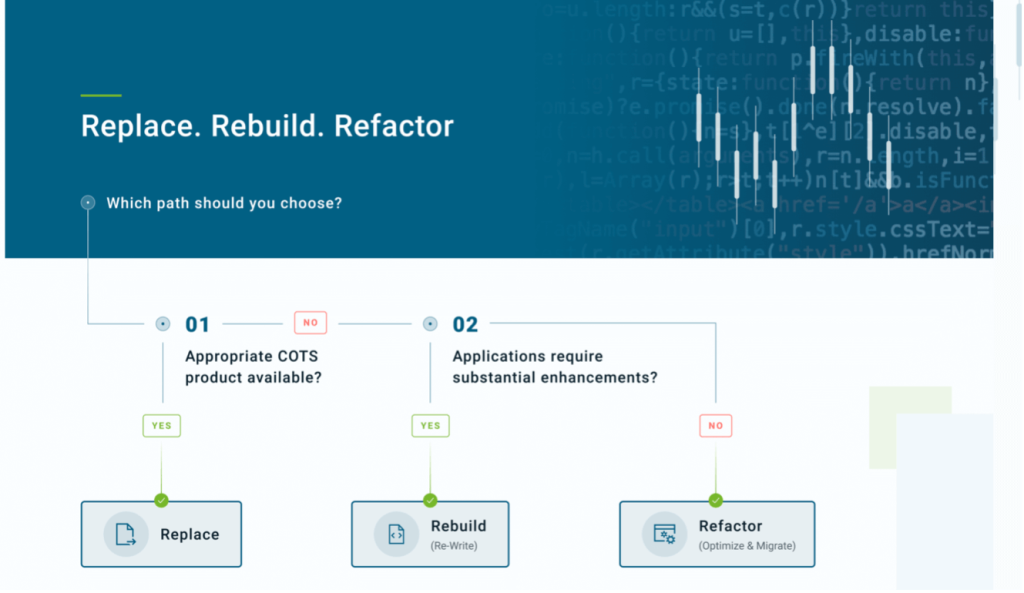
Once you’ve framed up the project and have a better sense for what would need to be done to get to your target application, you’re ready to determine which modernization path makes the most sense for you. The two main courses of action here would be either to extract business rules or to optimize the code and migrate it to a modern language. The way we think about making that decision is as follows:


One of the key decisions will be whether it makes sense and if there’s an appropriate commercial off the shelf (COTS) product available for you to implement your application in. This will involve your own research and due diligence on available third-party offerings to see if there is something available that will fit your needs. The other key decision will be whether your legacy application needs substantial enhancements or not, which is information you can derive from the assessment and analysis work done prior along with input on current environmental and business conditions. Once you’ve made these decisions on a per application and portfolio basis, you’ll be well equipped to determine whether it makes sense to replace or rebuild, which require rules extraction or refactor which hinges on optimization and migration.

Start Transforming your Applications

Now that you know how you can get to where you’re trying to go, it’s time to determine if you need additional tools or companies to facilitate that process and research the options if so. Factors that come into play might include:

  • What capabilities the tool offers. Does the tool provide you with the flexibility to choose different paths to modernization?
  • What programming languages the tool supports. Is the entire portfolio that you want to modernize covered from a documentation perspective? If you’re looking to migrate code, is the target language supported?
  • What levels of automation are supported by the tool. What kind of timeframes are you looking at for the project and is the level of automation sufficient enough to meet those goals?
  • Enabling collaboration between business analysts and technical personas. Does the tool provide outputs that facilitate decision making across the business?


Once you have selected a tool, it is always wise to carry out a proof of concept to test the outcomes that you are trying to achieve. A good vendor will work with you on this process and help set expectations accordingly for you to plan budget and resources necessary. Application modernization can feel daunting without the right information and the right approach. By arming yourself with knowledge and a step-by-step decision making process, you’re able to make an immensely complex undertaking more manageable while also setting yourself up as best as you can for success.


To learn more about how the Intellisys platform enables multiple application modernization use cases, click here or contact us.

Application Modernization has been recognized as a major initiative for the US government for at least a few years now. The Modernizing Government Technology Act enacted in 2017 created the Technology Modernization Fund that provided a new funding model for federal agencies to apply for a budget to update their legacy applications. And the President’s Management Agenda for 2018 identified the number one cross-agency priority goal as IT modernization given the recognition that over 2/3 of the federal IT budget has been spent on running and supporting legacy systems.

However as of April 2021 according to the Government Accountability Office (GAO), only 2 out of 10 critical federal systems that need to be modernized have fully developed plans to that effect. Some of the challenges have included appropriately planning and budgeting for modernizing legacy systems, a lack of suitable leadership, and acquiring a deep understanding of what systems look like and what paths are available to create that plan in the first place. Many of these are complex, critical systems where attention to detail is paramount.

Given potential security vulnerabilities, the benefits of cost reduction for running these applications, and the ability to move these applications into the cloud and reap those advantages once modernized, it is important for government agencies to prioritize funding these projects. To mitigate some of the perceived and associated risks, we recommend some of the following:


Don’t skimp on getting the full picture of your legacy applications

We’ve spoken before about the importance of documentation and gaining the foundational understanding of your application set. This becomes even more important the more complex and interconnected systems are. These details provide you with the knowledge base for which to determine your entire modernization plan on including which applications to keep, which ones to move away from, and which ones need to substantially updated. In addition, it is important that this information is available to both technical and business focused personnel. Business requirements are just as important as the technical requirements and modernization projects will require strong collaboration between the two parties.

Deeply consider your modernization options to optimize for long-term success


In general, there are two paths to modernization – business rules extraction or code optimization and migration. While direct code migration may seem attractive and a less time consuming way to quickly go from your legacy code to a newer programming language, this may not always be the best solution. Depending on the state of your original code, the logic inside, and your target application objectives, it may instead make sense to extract the business rules. For example, if there have been changes in regulations that may have changed or programs that have evolved, it is valuable to understand what exactly needs updating in a future version of the application. And in order to facilitate doing this in the most efficient and accurate way possible, it is important to find a tool that uses automation in the business rules extraction process along with the help of your subject matter experts (SMEs).

Go step by step and validate your desired outcomes


One of the most important things to recognize is that this is a learning game. It is imperative to start small and test out your desired outcomes to ensure that the process and tools you’ve chosen make sense for your final objectives and budget and resource planning. With this being the case, we recommend doing a proof of concept prior to committing to an entire modernization project. In that way, you can test the waters and adjust as needed without sacrificing a huge part of your budget or having to cancel large contracts if the outcomes are not as expected. Having taxpayer dollars and precious funding go down the drain is never ideal and this is one way to mitigate the extent of it and guide your project to success.

To learn more about EvolveWare and how the Intellisys platform can help you modernize critical systems, click here or contact us today.

As the “baby boomer” generation approaches retirement age, CIOs and IT decision makers are beginning to see the gaps that their departures create. The talent pool entering the workforce are trained in modern technologies and have no knowledge or interest in understanding or learning systems that were developed in yesteryears.

Unfortunately, most large organizations still run a significant part of their operations using software applications that had been developed decades ago. Last year, we saw some potential ramifications of this issue when unemployment claims went up due to the environment created by the pandemic and state government systems weren’t able to keep up. These governments needed the help of COBOL programmers, many of whom have now retired and continue to retire.

This evolution from an older, loyal workforce with business and legacy programming language knowledge to a younger, more mobile employee base poses significant challenges, particularly in the context of maintaining and supporting legacy systems that still account for a sizeable portion of most organizations’ application portfolios.

The retirement of experienced staff threatens to leave many organizations without access to their vast wealth of knowledge gained from years of experience working with systems that they inherited or wrote to help the business grow. In most cases, this knowledge, which was developed in a time of rapid technological advances and covered a wide range of technologies, is extremely difficult to re-create. This is because significant portions of this knowledge will not have been formally documented because the existing staff ‘just knew how to do it’. In fact, it is estimated that 70% of organizations have no referenceable documentation of their existing systems.

Unfortunately, the only way that their successors are finding out that they are missing critical information is when things go wrong or when they need to make detailed changes to existing systems. This is leading to costly mistakes, poor quality, service interruptions and project delays.

Organizations are often affected for months or years after an experienced worker has retired because of this lack of documentation. The problem is further exacerbated by the current trend towards outsourcing application support to third parties who will only have a very narrow view of the overall portfolio and whose only focus is to manage the immediate problem instead of addressing larger issues at hand.

The result is that replacement staff has to work in an environment riddled with gaps of missing knowledge, which leads to tedious and time-consuming knowledge recovery and retention work. It also takes them away from working on more forward-looking and lucrative initiatives.

So how can organizations create a repository of knowledge that is currently embedded in the minds of key employees? Automated software documentation is a key part of the solution.

Capture the knowledge through documentation, before it walks out of the door

Businesses that hope to maintain their efficiency during a time of change must implement a solution for capturing application knowledge and making it accessible to those who need it. Failure to do so can result in project cost over-runs, the inability to respond to market or regulatory change, a deterioration in customer service and ultimately the loss of reputation.

By using automated application documentation to capture and keep current the knowledge embedded within applications, organizations can avoid having to ‘reinvent the wheel’ and minimize the associated cost, time and risk factors associated with maintaining their application portfolio.

This documentation also creates a “corporate brain” that can ease the transition of applications from the current state to the future state.

How can an automated software documentation process help an organization secure this knowledge?

EvolveWare’s Intellisys Platform can automatically extract metadata from software applications and create easily readable documentation that can be understood and used by the organization for maintenance, support, and training purposes. Compared to other efforts to generate documentation, Intellisys is able to reduce the time spent to generate results by 90% or more.

This enables the existing staff to understand and share the inner workings of the applications, without having had first-hand knowledge of its creation and subsequent changes over many years. Whether it is the newest member of the staff, the most seasoned veteran, the detailed technical specialist or the business analyst, automated software documentation allows them to understand the full picture so that they can intelligently manage the application portfolio. In addition, the platform allows organizations to redocument their applications after making any updates, ensuring that knowledge continues to stay current.

Will your new hires be able to benefit from the knowledge source that their predecessors leave behind? Have you provided your retiring employees with the tools needed pass on their valuable knowledge?

The Intellisys platform can help you answer “yes” to those questions.

Click here to learn more about Intellisys’ automated software documentation and analysis capabilities or, contact us for more information.

Spec-driven development is a faster, more flexible alternative to traditional legacy modernization, where organizations first generate comprehensive technical specifications from a legacy system — capturing both what the code does and why — before migrating to modern technology. This article walks through Intellisys’ 5-phase process for putting this into practice (mapping legacy metadata, refining it, generating agnostic tech specs with LLMs, generating modern code from those specs, and testing the result), backed by a real-world case study of a US-based accounting firm modernizing a 3-million-line PowerBuilder application.


Key Takeaways:


  • Spec-driven development flips traditional modernization. Instead of translating legacy code line by line, organizations first generate technology-agnostic technical specs that capture what a system does and why — then use those specs as the blueprint for migration.
  • Specs simplify long-term maintenance. Once migrated, future changes happen at the spec level instead of through granular code edits, reducing dependency on developers fluent in the original legacy language.
  • The process runs in five phases: mapping and refining legacy metadata, generating specs with LLMs, generating modern code from those specs, and validating the result through rigorous testing.
  • Automation is high and verified. Code generation is 90%+ automated, with all output run through third-party tools to check for vulnerabilities before deployment.
  • The approach works in practice. A US-based accounting firm is using this process to modernize a 3-million-line PowerBuilder application, validated through a client-approved proof of concept.


For decades, enterprise organizations have been tethered to legacy applications that, while foundational to their operations, have become increasingly expensive and risky to maintain. The traditional methods of code modernization—often involving manual code rewrites or “lift-and-shift” migrations—frequently fall short, resulting in budget overruns, extended timelines, and systems that still carry the technical debt of their predecessors. However, a new era has arrived, centered on AI-Augmented spec-driven development. By leveraging automatically generated technical specifications as the blueprint for migration, organizations can finally break free from legacy constraints.

The Problem with Traditional Migration


Most organizations recognize that standing still with legacy systems is expensive. These systems often lack scalability, carry security vulnerabilities, and face a growing skills gap as the developers who originally wrote the code retire. Despite this, many modernization projects fail because teams lack a deep understanding of the legacy environment and attempt to translate the code line by line.

This approach is fraught with peril: it preserves obsolete logic, ignores hidden dependencies, and perpetuates code bloat—all while failing to capture the “why” behind the original code.

The new way to migrate code moves away from this flawed approach, instead generating a comprehensive set of technical specifications (tech specs) before a single line of new code is written. This shift delivers two key benefits:

  • Technology-agnostic clarity: Specs describe the source system in detail without requiring developers to be fluent in its original technologies
  • Simplified maintenance: Changes to the transformed system can be made at the spec level, rather than requiring granular code-level edits


Turning these benefits into reality requires a structured, phased process—beginning with detailed extraction of metadata from the source application. Here’s how
the Intellisys platform puts that process into practice.

Phase 1: Mapping the Legacy Landscape


The first step in a spec-driven migration is gaining complete visibility into the existing application portfolio. Intellisys facilitates this through its Documentation & Analysis toolsets, which extract metadata from the source system and use it to provide a 100% automated set of reverse-engineering artifacts.


Instead of spending months manually mapping out old codebases, Intellisys uses custom-trained AI/ML technologies to generate these documentation artifacts with 90% less time and effort than traditional methods. 


These artifacts allow architects to:

  • Analyze implemented logic and understand the impact of potential changes.
  • Identify hidden dependencies that could create risks during the migration window.
  • Keep documentation continuously updated as the legacy system evolves during the project, eliminating the need for code freezes.


The same metadata that is used to generate these artifacts also enables the successful generation of technical specifications.

Phase 2: Refining the Metadata


Before the tech specs themselves are generated, the extracted metadata must be optimized. Intellisys includes robust optimization features that reduce complexity, ensuring the specs built from this metadata describe not just a copy of the old system, but a modernized blueprint that meets today’s standards for scalability and security.


The goal is for the target code to have zero vulnerabilities, as measured by leading code quality tools. By optimizing the metadata before the specs are generated, organizations mitigate the risk of carrying legacy security flaws into their new environment.


Phase 3: Building the Blueprint for Spec-Driven Development


Once the code has been refactored, Intellisys uses large language models (LLMs) to automatically generate agnostic technical specifications. These specifications are the blueprint that the client will use moving forward to transform and maintain the new application. Here is a sample tech spec:


Phase 4: Generating Modern Code from Specs


Once the tech specs have been generated, the Intellisys platform then uses them to migrate code to modern technologies using locally installed GenAI models. While some GenAI powered migration methods have struggled with the nuances of specialized legacy languages, the Intellisys platform provides the extracted context necessary to guide these models accurately. The generated code is 90% + automated, with some case studies having an even higher rate of automation.


The new system can then be maintained from the technical specifications themselves. When requirements change, the organization can edit from the spec and then regenerate the code from there. There are no proprietary mechanisms or libraries when using Intellisys, and the code is run through 3rd party tools to ensure that no vulnerabilities are present.


Phase 5: Testing the Target System


After the modern system is generated, unit and regression testing must be performed for each module as well as all integrated modules. This testing will validate that individually generated functions and methods behave correctly as well as that the system as a whole behaves as expected. Parallel testing with the source system in production can also be conducted to ensure the results match before placing the modern system into production.


Real-World Success: Accounting Firm


EvolveWare is partnering with a US-based accounting firm to modernize a PowerBuilder application of approximately 3MM lines of code as the first part of a much larger project. The spec-driven development process detailed above was tested through a proof of concept to validate all steps on a smaller piece of the application, and the client reviewed and accepted the results after all tests passed.


Named in the 2026 Gartner® Magic Quadrant™ for AI-Augmented Code Modernization Tools, the Intellisys platform offers several distinct advantages for this client and others:

  • Unparalleled Language Support: Supports 20+ legacy and modern languages, including COBOL, PowerBuilder, Natural/ADABAS, and Java.
  • Reduced Risk: A phased approach — Align, Assess, Select, Pilot, and Scale — lets organizations validate their approach before committing to full-scale migration. 
  • Security and Accessibility: The platform can be installed on-site or hosted to meet strict security policies, is accessible to authorized personnel via web-based interfaces, and runs all AI models locally to keep data secure.
  • Cost and Time Savings: Automating documentation, business rules extraction, and code migration significantly reduces the manual labor of modernization, letting teams move to modern systems faster.


Modernization, Re-imagined


The time and risk associated with legacy modernization have long been a blocker for organizations looking to move forward. But as technology evolves, that equation is shifting—modernization is becoming both more urgent and more achievable, as new tools make the process faster and more flexible than ever before.


By generating technology-agnostic tech specs as the foundation for migration, Intellisys turns that shift into a concrete path forward—one where organizations no longer have to choose between standing still and betting everything on sub-optimal modernization strategies.


FAQ

What are technical specifications?

Technical specifications describe the requirements, features and characteristics of a product or system. They typically include functional and performance requirements, technical constraints, and interfaces amongst other details. They are useful from a modernization perspective because they describe the system in a developer-neutral manner so that organizations are not tied to the original programming language of the product or system and because they make future maintenance easier.

Spec-driven development is a software development approach where a detailed, structured specification is maintained and used to generate code as opposed to maintaining the code directly. This approach is useful for legacy modernization efforts as instead of migrating legacy applications by translating code line by line, organizations first generate a comprehensive set of technical specs that describe what the system does and why, independent of its original programming language. These specs then become the blueprint used to build the modern system, and any future changes are made at the spec level rather than through granular code edits — making the system easier to maintain and update over time.

Using automation and AI in the Intellisys platform, organizations can keep their systems documented in an on-going manner. The platform allows organizations to re-run code as changes are made back through the platform’s extraction engine. Intellisys identifies where changes have been made to the code and generates reports highlighting these changes. Intellisys can also regenerate technical specs if needed using the updated metadata.

The accuracy of AI-generated code is dependent upon the context provided to the models and the processes used to generate the target code. The Intellisys platform has a 90%+ automation rate after testing. The platform uses patented metadata extraction technologies to retrieve highly detailed context from the source system and leverages that to generate the technical specifications that are then used to generate code. All processes that use AI technologies in Intellisys are built using human-in-loop review processes and our phased approach ensures successful results at each stage.

Agile Business Rules Extraction (BRE) is a modern approach to identifying and documenting the policies and algorithms hidden within legacy software. Business rules are a fundamental component of system analysis and design. Using the Intellisys platform, organizations can uncover and leverage these rules or policies to ensure the success of digital transformation projects, such as re-imagining and rebuilding systems or migrating to modern platforms like Oracle ERP or low-code environments.


Key Takeaways:

  • The role of business rules in system analysis and design: Organizations that attempt system migrations without first extracting their legacy rules risk losing critical policies “in translation.” Having documented rules gives developers and AI models a reliable blueprint for rebuilding with confidence.
  • BRE helps clean up bloated software portfolios: The extraction process surfaces obsolete rules, duplicate logic, and dead code across systems — allowing organizations to rationalize their application landscape and cut unnecessary complexity.
  • Human-readable rules are a compliance superpower: In regulated industries, being able to point auditors to plain-English translations of cryptic COBOL or legacy code is invaluable. It removes the dependency on a handful of technical experts to explain system behavior.
  • Extracted rules inform smarter platform decisions: Rather than guessing which systems belong on a COTS product, a low-code platform, or a custom build, organizations can use rule complexity as an objective measure — as the U.S. Air Force did when evaluating 55 systems for Oracle ERP compatibility.
  • Agile BRE eliminates the dreaded “code freeze.” Traditional extraction required halting all policy updates during the process. Modern platforms like Intellisys allow continuous updates, ensuring extracted rules stay in sync with the live environment and are immediately usable in modernized systems.


In the world of IT, legacy systems are often described as “black boxes.” They perform critical functions—processing insurance claims, managing military logistics, or handling state-wide tax records—but the exact logic governing these functions is often buried under decades of code updates and lost documentation.


Business Rules Extraction (BRE) is the process of uncovering the policies and algorithms embedded within these systems. Once these rules are extracted, they cease to be “trapped” logic and instead become versatile assets that can drive an organization’s future. Based on the capabilities of the Intellisys platform, here is a deep dive into key use cases for business rules in system analysis and design, once they are successfully extracted from a legacy environment.


1. Driving Digital Business Transformation


The primary use for extracted business rules is to serve as the blueprint for digital business transformation. Many organizations find that their transformation initiatives—such as moving to the cloud or rebuilding a system from the ground up—stumble because they do not fully understand the logic running in their current environment.


By extracting these rules, organizations can:

  • Re-imagine and rebuild systems with confidence: Instead of guessing how a legacy system handles a specific edge case, developers have a documented list of rules to replicate or update in the new system based on evolving business needs.
  • Ensure functional parity: Extracted rules allow a new application to maintain the same business logic as the legacy version, ensuring that no critical policy is “lost in translation” during the migration.


2. Streamlining Portfolio Rationalization


Large organizations often suffer from “bloated” software portfolios where multiple systems perform overlapping functions. Extracted rules are the key to application rationalization.


Through the BRE process, organizations can identify:

  • Obsolete rules: Logic that is no longer used by the business but still exists in the code.
  • Duplicate rules: Situations where the same policy is being calculated or enforced in multiple ways across different systems.
  • Dead code: By using tools like Intellisys to deactivate “dead weight” and environment-specific code blocks, organizations can slim down their logic to only what is necessary for the business.


3. Satisfying Audit and Compliance Requirements


In highly regulated industries, it isn’t enough for a system to work; you must be able to prove how it works. Extracted business rules are invaluable for audit and compliance.


Legacy code is often written in cryptic languages (like COBOL or early Java) that auditors cannot read. BRE tools bridge this gap by providing a plain English translation of these tools. This allows both technical and management personnel to verify that the software is adhering to current legislative and business policies. If a regulator asks why a certain decision was made by the system, the organization can point to a specific, human-readable rule extracted directly from the source code. AI-Augmented platforms such as Intellisys use the latest technologies to automate the generation of these summaries, saving organizations more time and effort.


4. Facilitating Modern Platform Selection


One of the most strategic uses of extracted rules is informing the selection of a new technology stack. Not every legacy application belongs on the same modern platform. BRE helps organizations identify which applications are best suited for:


  • Commercial Off-the-Shelf (COTS) Products: For example, the U.S. Air Force wanted to do a comprehensive analysis of USAF legacy systems to determine whether the Oracle E-Business Suite Enterprise Resource Planning (ERP) system would be a good fit. To do so, they extracted and rationalized rules from 55 different systems to determine which ones should be implemented in the Oracle ERP suite and how best to do so.
  • Low-Code/No-Code Platforms: By understanding the complexity of the extracted rules, IT leaders can decide if an application can be moved to a low-code environment or if it requires a more robust custom build.


5. Architecting for Microservices


Modern software architecture is built on microservices—small, independent units of logic. Extracted business rules provide the “DNA” for these services. Once rules are extracted and consolidated, they can be transformed into modern code and used to define and generate specific microservices. This allows a massive, monolithic legacy application to be broken down into agile, manageable components that are easier to update and scale.


6. Bridging the Gap Between IT and Business


In many legacy environments, there is a “knowledge silo” where only a few senior developers understand the code. When business rules are extracted and exported into project management tools like Jira, they become visible to the entire organization.


This visibility allows for:


  • Better Informed Decisions: The State of New York extracted business rules from 31 million lines of legacy code written for their Integrated Eligibility System (IES). They then exported these rules into Jira to help them plan a rebuild of the entire IES system.
  • Clearer Communication: Because rules are presented at a granular level and annotated for readability, business stakeholders can provide feedback on the logic without needing to understand the underlying programming language.


The Importance of the "Agile" Approach


A significant challenge in traditional rules extraction is the “code freeze.” Historically, organizations had to stop making policy updates while the extraction took place. However, Agile BRE (as seen on the Intellisys platform) allows for continuous updates.


If a legislative policy changes while the extraction is in progress, the platform can automatically transfer those code updates without affecting unrelated rules. This ensures that the finalized, extracted rules are always in sync with the live business environment, making them immediately ready for use in a modernized system.


The Future of Business Rules in System Analysis and Design: User Stories and Tech Specs


Extracted business rules are more than just documentation; they are the functional core of each organization. Whether they are being used to rationalize a portfolio, validate a COTS platform, or generate microservices, these rules provide the clarity needed to move from a legacy-bound past to a digitally transformed future.


While extracting and understanding business rules will continue to remain important for all the reasons outlined above, the latest technologies are enabling organizations to use these higher level policies in a multitude of ways while reducing time and effort spent on transformation. Platforms such as Intellisys now allow automated generation of user stories or technical specifications. The user stories can be exported and used as part of a system re-write. The technical specifications can be automatically converted into code using spec-driven development tools or custom AI pipelines. 


With platforms like Intellisys bridging the gap between legacy logic and modern development, organizations no longer have to treat their past as a barrier — instead, they can use it as the blueprint for a faster, smarter, and more confident path forward.


Contact us to see how Intellisys can help leverage your business rules in system analysis and design use cases for legacy applications.

Article Summary: AI-assisted development is generating architectural technical debt faster than it resolves it— creating systemic instability for unprepared organizations. Adopting the right technical debt management tool to meet an organization’s requirements is imperative. EvolveWare has been recognized as a Representative Vendor in the 2026 Gartner® Market Guide for Technical Debt Management Tools. The company’s Intellisys platform helps organizations get ahead of this risk by providing deep visibility into existing systems across legacy and modern codebases.


According to the 2026 Gartner® Market Guide for Technical Debt Management Tools (accessible to Gartner subscribers only), “By 2028, AI will create more technical debt on architecture levels than it solves.”1 As organizations such as Microsoft and Anthropic roll out tools to address fixing code level technical debt, the remaining technical debt will be in architecture, system design, and dependencies. According to the Market Guide, that debt “creates systemic instability and long-term fragility.”1 This report is not the only one that mentions the potential pitfalls of AI-assisted development. In a report on the state of AI generated code, Sonar found that 61% of developers agree that AI often produces code that seems correct but isn’t reliable. They also found that 90% of issues associated with AI generated code are considered code smells or harder to pinpoint maintainability challenges. This means that a lot of potential time savings from using AI code generators are getting eaten up by oversight and verification that is required later. Or worse, if that verification is not performed, potential system failures may occur.


That’s why one of the report’s key recommendations is to “Prioritize the adoption of a technical debt management tool that addresses your most pressing need: architectural technical debt reduction, code quality improvement, application portfolio prioritization, or preparation for large scale system modernization.”1 EvolveWare is proud to be recognized as a Representative Vendor in this report. The company’s Intellisys Platform uses AI and automation to speed up and de-risk key processes involved in maintaining and modernizing applications, including providing robust documentation, diagrams, and reports of the current state of applications. Organizations can start simply by understanding their current systems and then use that information for future portfolio prioritization or modernization initiatives. For those who choose to rationalize or modernize their systems, the platform extracts unparalleled context from source systems and allows users to use that information to refactor first to power successful system migrations.


This is even more important for those with legacy systems or systems written in older technologies. With legacy systems there is the existing technical debt and then there is the new technical debt that is introduced when trying to adopt these newer AI technologies. If an organization is not careful, the compound of all of this can create major security gaps, budget overruns or complete shutdowns. Since the Intellisys platform supports reverse-engineering of applications written in 20+ languages including both legacy and modern ones, large organizations are able to assess entire portfolios written across multiple years as opposed to only being able to concentrate on a few. A State’s Department of Transportation used the tool to create an enterprise repository for consumable inventory applications written in COBOL, C#.NET with T-SQL, PL/SQL, and VB .NET prior to moving off the mainframe.


Organizations are also able to continue to assess the state of their code as changes are made. Intellisys supports agile documentation capabilities where newer versions of the source code can be processed and reports are generated identifying where changes to the code have been made and the impact. While working on a modernization initiative for their large IES system, the State of New York used this feature to identify where changes in the production code were made and how they impacted modernization work that had been performed prior to those changes. This ensured that the modernized version of the application would be in sync with any updates made to the production version of the code, as the project involved 31 million lines of legacy code and took 3 years to complete.


The relationship between AI adoption and technical debt is neither simple nor one-directional. AI offers productivity gains, but those gains come with architectural and maintainability costs that are only beginning to be fully understood. As the evidence from Gartner, Sonar, and others makes clear, the organizations best positioned to benefit from AI-assisted development are those that approach it with discipline — maintaining visibility into their systems, enforcing architectural standards, and actively managing the debt that accumulates over time.


For organizations carrying legacy systems into this new era, the stakes are particularly high. The compounding effect of pre-existing technical debt and the new debt introduced by AI adoption is not a theoretical risk — it is an operational one. The good news is that the tools and frameworks needed to manage this challenge are maturing alongside the AI technologies creating it. As AI continues to reshape how software is built and maintained, organizations that invest in understanding what they have today using a robust technical debt management tool will be far better equipped to make sound decisions about where they are going tomorrow.


To learn more about EvolveWare’s Intellisys Platform technical debt management tool capabilities, contact us.


1 Gartner, Market Guide for Technical Debt Management Tools, Tigran Egiazarov, Howard Dodd,Aaron Harrison, 13 April 2026

Gartner is a trademark of Gartner, Inc. and/or its affiliates

Gartner does not endorse any vendor, product or service depicted in its research publications, and does not advise technology users to select only those vendors with the highest ratings or other designation. Gartner research publications consist of the opinions of Gartner’s research organization and should not be construed as statements of fact. Gartner disclaims all warranties, expressed or implied, with respect to this research, including any warranties of merchantability or fitness for a particular purpose.

Article Summary: Thorough legacy application mapping and documentation is an essential prerequisite for any modernization effort. Undocumented legacy systems carry serious risks including hidden security vulnerabilities, mounting technical debt, and the danger of losing critical business logic during migration. Modern AI-powered tools have dramatically accelerated this process — reducing documentation time by over 95% and enabling continuous updates without code freezes. Real-world examples, including a Department of Defense system and a global insurance company, demonstrate that investing in documentation first leads to faster, higher-quality modernization outcomes. Keep reading to learn more.


In the world of enterprise IT, legacy systems are often treated like ancient, mysterious artifacts. They are foundational to the business, yet few people truly understand how they work from the inside out. As the original developers who built these systems retire from the workforce, organizations are left with millions of lines of code—often in languages like COBOL, Fortran, or PowerBuilder—that have been patched and extended for decades. This “black box” scenario creates a significant barrier when it comes time for legacy modernization.


Many organizations realize that legacy application mapping or creating application documentation is not just a secondary administrative task; it is a critical requirement for future planning and a fundamental prerequisite for any successful transformation, even more so when using newer AI technologies. Without a comprehensive understanding of the current state, any attempt to modernize is akin to sailing into a storm without a compass.


The Hidden Risks of Undocumented Code


The lack of in-depth understanding regarding source code is one of the primary challenges that compromises an organization’s ability to generate scalable future applications. Legacy systems that have been modified over many years often contain hidden security vulnerabilities, making them prime targets for hackers. Furthermore, these systems typically carry immense technical debt, which create unnecessary costs for organizations. In a recent Deloitte survey on Global Technology Leadership, they estimate that technical debt accounts for 21% to 40% of an organization’s IT spending.


When thorough legacy application mapping is missing or outdated, the risks of modernization skyrocket. There is a very real fear of unknowingly leaving out a vital business rule or a critical line of code during the migration process. This is particularly true for large-scale government or enterprise projects where hundreds of systems may be interconnected and where regulations are a large concern. For example, the Department of Defense once struggled with a critical recruitment system that had become impossible to maintain because so little knowledge existed regarding its internal workings, as it had been developed by multiple third-party vendors over several years and no current documentation existed. The system had essentially failed by the time modernization became imperative.


Application Assessment Infographic Introduction


Legacy Application Mapping as a Strategic Foundation


Modernization is rarely a one-size-fits-all process. Depending on the organization’s goals, the path might involve a Business Transformation or a Technology Transformation.


  • Business Transformation: This involves changing business models and processes. In this scenario, Agile Business Rules Extraction (BRE) is essential. Detailed documentation allows subject matter experts to identify and extract embedded business logic and policies so they are not lost when moving to a new platform like a COTS or Low-code/no-code environment. It will also allow organizations to identify which rules to keep, update and/or retire for their future system(s).
  • Technology Transformation: This focuses on replacing outdated systems to reduce costs and staff attrition risks. Here, the modernization path typically chosen is Code Optimization & Migration. Current documentation helps with determining how to best optimize the code prior to migrating it, allowing developers to identify and deactivate dead or unwanted code before migrating to a modern language like Java or C#. In addition, code transformation to modern technologies is only as successful as the detail or context provided to it. This context relies on the mapping or documentation generated.


In both cases, obtaining a foundational understanding of the application is the first step.

The Power of Automated Documentation


Traditionally, documenting a legacy system was a manual, grueling process that required months of interviews and code reviews. However, modern platforms like Intellisys have revolutionized this by using AI and machine learning to automate the process.

Automated documentation provides several game-changing benefits:

  1. Speed and Efficiency: Automation can lead to a 95%+ reduction in the time required to generate application documentation. 
  2. Accuracy and Completeness: Human error is a significant risk in manual documentation. Automated bookkeeping ensures that no critical dependencies or data flows are missed. 
  3. Continuous Updates (No Code Freezes): One of the biggest hurdles in modernization is the “code freeze,” where developers must stop making changes to the live system while it’s being documented. Advanced automation allows the documentation and knowledge repository to be continuously updated even as changes are made to the legacy application.

Accessibility for Non-Experts: Documentation “translates” legacy code into a format that more people can understand. As noted by technical leads at BMI, automated tools like Intellisys make COBOL code available to a large group of people who are technical but not fluid in mainframe programming, allowing them to see program relationships and attribute changes clearly.


Real-World Examples


The criticality of documentation is best seen through the success of organizations that prioritized it. The Department of Defense, for instance, was able to transform the old, undocumented recruitment system mentioned above into a modern, multi-tiered Java architecture in record time by using automated optimization and migration solutions. By first establishing a 100% automated extraction of metadata, they were able to document, modernize, and deploy a system of 220,000 lines of code in just 6.5 months.


Similarly, a Global Insurance Company was facing critical risks across legacy systems powering insurance policy renewals, premium calculations, and claims processing. Documenting these systems to both plan the modernization effort as well as provide essential context for code migration was key. Due to the robust nature of the mapping provided, 2 million lines of legacy code in IBM iSeries COBOL, Oracle Forms & Reports, and .NET were migrated to modern Java and .NET at a 95% automation rate.


Agile Documentation Enables Continuous Modernization


In the rush to adopt new technologies like the cloud, AI, or microservices, it is tempting to skip the “boring” work of legacy application documentation. However, the evidence from the sources is clear: documentation is the key to modernization success. It reduces maintenance costs, identifies vulnerabilities, preserves critical business rules, and provides the “evidence” needed to make smart decisions about the future of an application portfolio.


It is vital to view documentation not as a one-time project, but as a living asset. The most successful modernization journeys involve creating an application knowledge base that evolves with the transformation. Once an application is moved to a modern language, maintaining that documentation ensures the organization never falls back into the “black box” trap.

Modernization is a journey. But you can’t know where you are without the legacy application mapping that documentation provides. Whether you are aiming for a total business transformation or a targeted technology update, your first step should always be to understand your applications to plan for the future.


To learn more about legacy application mapping within the Intellisys platform, download our infographic or contact us.


Gartner® recently released their 2026 Market Guide for AI-Augmented Code Modernization Tools . The report defines AI-Augmented code modernization tools as “software solutions that use specialized AI agents, generative AI, and deterministic analysis to accelerate the transformation of legacy systems. These tools automate and enhance a broad spectrum of modernization activities, including deep code and architecture analysis, software documentation, dependency mapping, risk assessment, migration planning, and refactoring.”1 EvolveWare is thrilled to be named as a Representative Vendor in the 2026 Gartner Market Guide for AI-Augmented Code Modernization Tools report for its Intellisys Platform, a solution that automates core processes in the modernization journey using an AI-led process.


The report mentions that “AI-augmented tools are poised to fundamentally reshape the economics of application modernization, enabling organizations to achieve greater efficiency, scalability, and compliance.”1 We’ve seen similar viewpoints asserted by others in the industry such as Anthropic, as they compare these modernization initiatives to ones done manually in the past. And we at EvolveWare agree that these tools can be used to better understand applications, minimize risk, and properly plan out modernization efforts. The ways in which GenAI technologies are now successfully used to speed up modernization efforts is an evolution of a trend that started 20+ years ago with older AI technologies. At the same time, the costs of not modernizing only continue to increase. More and more legacy technologies are experiencing looming end-of-support dates, and the pool of talent that understands these technologies continue to dwindle, making maintaining these systems exponentially more expensive and risky.


The question then becomes how effective these tools and technologies are at delivering successful modernization efforts. The report states that “AI-augmented code modernization tools can materially accelerate legacy application modernization, but cannot fully automate them. Human oversight and experienced developers remain essential.”1 In our experience, this is what we’ve seen as well. In one of our most recent projects with a Fortune 50 Insurance company, we used the Intellisys platform to document and understand 6.255MM lines of code written in languages including COBOL, Oracle Forms & Reports, legacy .NET and more as well as transform 2MM lines of code to modern .NET and Java using a GenAI led process. While we were able to reach a 95% automation level for complete and compilable code, we include a human in the loop review and testing process by partnering with the client to ensure the code is working as expected prior to going into production. Using this combination of AI, automation, and human oversight, we were able to save the client thousands of developer hours based on their own estimates.


Ultimately, any modernization project involves putting together the right team, processes, and tools in order for it to be successful. With AI-augmented code modernization tools, the economics around modernization are improving but require the correct processes, alignment, and implementation to realize expected gains. The Intellisys Platform is an example of a tool that provides a solution for each of these inputs:

  • Uses a phased approach to modernization that starts with using its patented extraction technology to provide a comprehensive understanding of your legacy applications.
  • Presents business logic in multiple formats including a format that is more of an “English-like” translation for non-technical users, enabling collaboration.
  • Incorporates the latest AI technologies where they provide value such as automated summaries of business rules and code transformation using Intellisys generated context


To learn more about how AI is used in EvolveWare’s Intellisys Platform to help with your modernization efforts, contact us.


1 Gartner, Market Guide for AI-Augmented Code Modernization Tools, Prasanna Lakshmi Narasimha, Howard Dodd, C.A. Swan, Erin Khoo, 2 February 2026

GARTNER is a registered trademark and service mark of Gartner, Inc. and/or its affiliates in the U.S. and internationally and is used herein with permission. All rights reserved. Gartner does not endorse any vendor, product or service depicted in its research publications, and does not advise technology users to select only those vendors with the highest ratings or other designation. Gartner research publications consist of the opinions of Gartner’s research organization and should not be construed as statements of fact. Gartner disclaims all warranties, expressed or implied, with respect to this research, including any warranties of merchantability or fitness for a particular purpose.

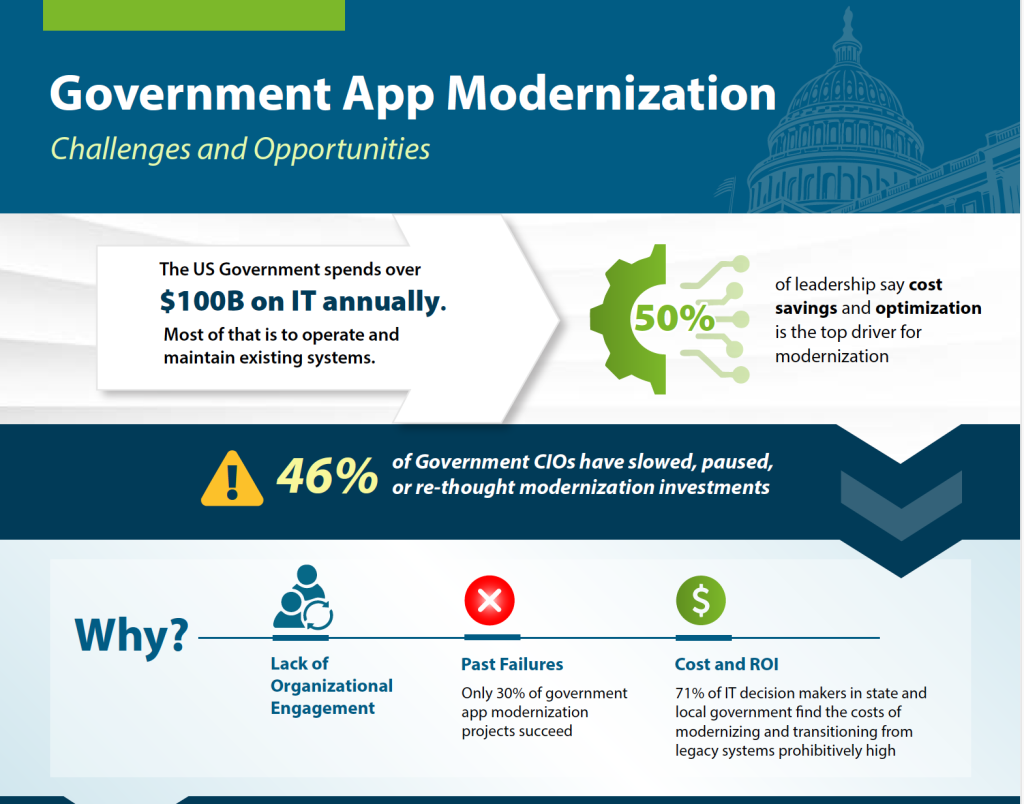
Earlier this year, the Pennsylvania Office of Administration (OA) reported $37 million in cost savings attributed to modernized legacy technologies and financial management. The benefits of modernization, when planned and executed using a successful formula, are both known and documented. And yet, the US government itself spends over $100B on IT where most of it is to maintain and operate existing systems. Last year despite the promise from the Department of Government Efficiency (DOGE)  to modernize federal technology to reduce inefficiencies, their efforts seemingly made it more difficult for agencies to access and adopt the latest innovations. Government modernization only becomes more imperative as the years go by, particularly with the retirement of the current workforce and the acceleration of innovation. In order to cross the bridge successfully, agencies must first identify and then tackle common modernization challenges in government.

Top Modernization Challenges in Government and How to Address Them

Government Application Modernization

Lack of organizational engagement:

Modernization initiatives require backing from the C-suite and leadership teams. In the public sector, there is constant pressure to justify spending and outcomes and scrutiny is high regardless of the level of government or particular state agency. In addition in any regulated organization, the costs of making changes to the systems that execute or oversee these regulations can seem extraordinarily high, leading to lackluster support from leadership teams. The old adage of “why fix what isn’t broken” rings even more true in government.

→Addressing this modernization challenge in government: 

  • Build your coalition of support early on in the project. Continue to keep this coalition informed as the project progresses.
  • Present actionable solutions including the business and not just the IT case. Explore words of wisdom from a former CIO of the Air Force.
  • Keep a transparent record of the project, steps taken and presenting visible milestones and results. 
  • Highlight the actual and opportunity costs of not modernizing to show the true cost of delaying these initiatives.


Enduring legacy of past failures:

It is estimated that only 30% of government app modernization projects have succeeded in the past. With that level of success rate, it can be hard to get past the above mentioned mentality of “if it’s not broken why fix it” as these projects require significant time and resources. It’s important to identify and address why these past efforts may have failed to not make the same mistakes. Reasons include:

  • Trying to do everything at once or going with a “big bang approach” which was high risk and frequently led to modernization efforts over budget that also underperformed.
  • The level of manual services that were used to pore over thousands if not millions of lines of code. Particularly in industries dealing with critical changing regulations, this kind of work requires automation to avoid costly errors and mistakes.
  • Not having a complete understanding of systems prior to planning and modernizing them. 


→Addressing this modernization challenge in government:

  • Use a phased approach to first assess your current set of applications and then plan and implement a modernization effort. See how a state’s Department of Transportation used this in practice.
  • Select a tool that uses automation including AI technologies to both speed up and reduce the risk involved in these efforts.
  • Thoroughly assess your current systems including understanding linkages, dependencies, logic and more. The more information and knowledge you have to learn from and build off of, the better the conclusion of a transformation effort.


The cost and ROI trade-off of modernization efforts
:


In a recent survey, 71% of IT decision makers in state and local government found the costs of modernizing and transitioning from legacy systems prohibitively high. With such large-budget endeavors, ROI must be significant to compel investment in these projects. But agencies don’t think about ROI in all the same ways that a private organization would. While both sides think about cost savings and internal efficiencies, agencies also think in terms of “public value”, including a heavier emphasis on providing services in a timely manner, mitigating security challenges, and general public opinion on their execution. Estimating these aspects of ROI can be a complex endeavor, but government agencies must show ROI on every dollar spent on technology as budgets can be constrained. 

→Addressing this modernization challenge in government:

  • Use application rationalization as an intermediary step to inventory and assess your portfolio of applications for business, value, cost, and technical fitness. This will start you off on a lower budget, provide more immediate cost savings, and help you prioritize where to invest in modernization efforts.
  • Include public value related metrics in your ROI calculations. These could include estimated service delivery efficiencies, security incident reductions, or even access improvements.
  • Consider how modernization could allow the use of new technologies such as AI to add new or increase improvement in public value related metrics. Include these estimations when looking at the trade-offs in moving forward with modernization efforts

Moving Forward with Confidence

Government modernization is not optional—it’s essential. The barriers are real, but they’re not insurmountable. Agencies that have succeeded share common traits: they build broad coalitions early and stay aligned with those coalitions, they embrace phased approaches over big-bang transformations, and they leverage automation to reduce both risk and cost.


Citizens are in need of better and more efficient services. Both the workforce and the technology landscape are evolving. The question isn’t whether modernization is worth it, but whether your agency feels confident to tackle the unique modernization challenges in government. Are you ready? The bridge to modernization is there—it’s time to cross it.

Categories

Checkbox filter for category

Learn More About the Intellisys Platform

Icon for platform overview and assessment of legacy systems

Overview of the
Intellisys Platform

Icon for automated code documentation tool for modernization

Documentation & Analysis

Icon for agile modernization in government and enterprise projects

Agile Business Rules
Extraction

Icon for modernizing legacy code without rewriting

Code Optimization & Migration

Intellisys: Supported Technologies

  • ADSO

  • ASP

  • Assembler

  • C/C++

  • CL/DCL/ECL/JCL

  • C#.Net 

  • COBOL

  • Cold Fusion

  • EasyTrieve

  • Forte

  • Fortran

  • Foxpro
  • Java
  • Natural/ADABAS
  • Oracle Forms
  • PACBASE
  • PL/1
  • PL/SQL T/SQL
  • PowerBuilder
  • RPG
  • Universe Basic
  • Visual Basic
  • VB.Net
Languages Popup Image