
Earlier this year, the Pennsylvania Office of Administration (OA) reported $37 million in cost savings attributed to modernized legacy technologies and financial management. The benefits of modernization, when planned and executed using a successful formula, are both known and documented. And yet, the US government itself spends over $100B on IT where most of it is to maintain and operate existing systems. Last year despite the promise from the Department of Government Efficiency (DOGE) to modernize federal technology to reduce inefficiencies, their efforts seemingly made it more difficult for agencies to access and adopt the latest innovations. Government modernization only becomes more imperative as the years go by, particularly with the retirement of the current workforce and the acceleration of innovation. In order to cross the bridge successfully, agencies must first identify and then tackle common modernization challenges in government.
Top Modernization Challenges in Government and How to Address Them
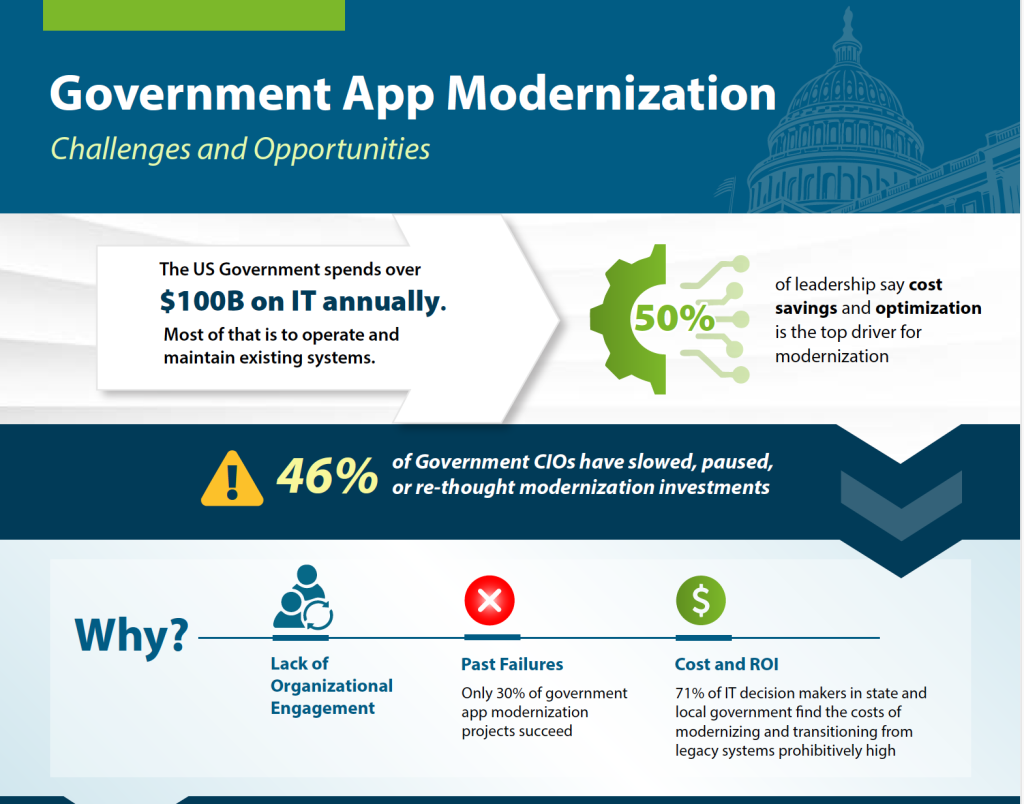
Lack of organizational engagement:
Modernization initiatives require backing from the C-suite and leadership teams. In the public sector, there is constant pressure to justify spending and outcomes and scrutiny is high regardless of the level of government or particular state agency. In addition in any regulated organization, the costs of making changes to the systems that execute or oversee these regulations can seem extraordinarily high, leading to lackluster support from leadership teams. The old adage of “why fix what isn’t broken” rings even more true in government.
→Addressing this modernization challenge in government:
- Build your coalition of support early on in the project. Continue to keep this coalition informed as the project progresses.
- Present actionable solutions including the business and not just the IT case. Explore words of wisdom from a former CIO of the Air Force.
- Keep a transparent record of the project, steps taken and presenting visible milestones and results.
- Highlight the actual and opportunity costs of not modernizing to show the true cost of delaying these initiatives.
Enduring legacy of past failures:
It is estimated that only 30% of government app modernization projects have succeeded in the past. With that level of success rate, it can be hard to get past the above mentioned mentality of “if it’s not broken why fix it” as these projects require significant time and resources. It’s important to identify and address why these past efforts may have failed to not make the same mistakes. Reasons include:
- Trying to do everything at once or going with a “big bang approach” which was high risk and frequently led to modernization efforts over budget that also underperformed.
- The level of manual services that were used to pore over thousands if not millions of lines of code. Particularly in industries dealing with critical changing regulations, this kind of work requires automation to avoid costly errors and mistakes.
- Not having a complete understanding of systems prior to planning and modernizing them.
→Addressing this modernization challenge in government:
- Use a phased approach to first assess your current set of applications and then plan and implement a modernization effort. See how a state’s Department of Transportation used this in practice.
- Select a tool that uses automation including AI technologies to both speed up and reduce the risk involved in these efforts.
- Thoroughly assess your current systems including understanding linkages, dependencies, logic and more. The more information and knowledge you have to learn from and build off of, the better the conclusion of a transformation effort.
The cost and ROI trade-off of modernization efforts:
In a recent survey, 71% of IT decision makers in state and local government found the costs of modernizing and transitioning from legacy systems prohibitively high. With such large-budget endeavors, ROI must be significant to compel investment in these projects. But agencies don’t think about ROI in all the same ways that a private organization would. While both sides think about cost savings and internal efficiencies, agencies also think in terms of “public value”, including a heavier emphasis on providing services in a timely manner, mitigating security challenges, and general public opinion on their execution. Estimating these aspects of ROI can be a complex endeavor, but government agencies must show ROI on every dollar spent on technology as budgets can be constrained.
→Addressing this modernization challenge in government:
- Use application rationalization as an intermediary step to inventory and assess your portfolio of applications for business, value, cost, and technical fitness. This will start you off on a lower budget, provide more immediate cost savings, and help you prioritize where to invest in modernization efforts.
- Include public value related metrics in your ROI calculations. These could include estimated service delivery efficiencies, security incident reductions, or even access improvements.
- Consider how modernization could allow the use of new technologies such as AI to add new or increase improvement in public value related metrics. Include these estimations when looking at the trade-offs in moving forward with modernization efforts
Moving Forward with Confidence
Government modernization is not optional—it’s essential. The barriers are real, but they’re not insurmountable. Agencies that have succeeded share common traits: they build broad coalitions early and stay aligned with those coalitions, they embrace phased approaches over big-bang transformations, and they leverage automation to reduce both risk and cost.
Citizens are in need of better and more efficient services. Both the workforce and the technology landscape are evolving. The question isn’t whether modernization is worth it, but whether your agency feels confident to tackle the unique modernization challenges in government. Are you ready? The bridge to modernization is there—it’s time to cross it.


